


 (509) 430-0090
 Quick answer: A custom golf cart’s cost comes down to the build. A few upgrades like wheels and lighting are a smaller, weekend-friendly project, while a fully custom, lifted, lithium-powered, street-legal cart is a larger investment that typically runs into the five figures. The only way to get your exact number is a free, no-pressure quote built around the cart you actually want.
Summer in the Inland Northwest pretty much runs on golf carts. They’re parked at the lake, lined up at the campground, and cruising every cart-friendly neighborhood from Post Falls to Coeur d’Alene. And every summer, the same question lands in our inbox: what does a cart like that actually cost to build?
Fair question, and we’ll answer it straight. We’re Amped Up Carts, a custom golf cart shop in Post Falls, and we build carts for exactly how people live up here: lake days, campsites, neighborhood loops, hunting trips, and the occasional actual round of golf. Here’s the real breakdown of what goes into a build, what moves the price, and how to start yours while there’s still plenty of summer left to enjoy it.
Key Takeaways
- Custom golf cart pricing depends on the build, from a light refresh to a full five-figure custom ride.
- The biggest cost drivers are the base cart, the lift, wheels and tires, lithium power, and seating.
- Lithium conversions are the most transformative upgrade for summer daily drivers: lighter, faster, longer range, low maintenance.
- Many Idaho and Washington carts can be made street legal with the right equipment, and we handle the setup.
- Amped Up Carts builds in-house in Post Falls, offers free pickup and delivery across the Inland Northwest, and gives a free, no-pressure quote.
What Is A Custom Golf Cart, Exactly?
Quick answer: a custom golf cart is a cart built beyond its factory form, with upgrades like a lift, custom wheels and tires, lithium power, added seating, lighting, sound, and street-legal equipment, all tailored to how you actually plan to use it.
In other words, it starts as an ordinary cart and becomes something built around your life. And despite the name, most custom carts up here rarely touch a golf course. They are neighborhood cruisers, lake haulers, campground rigs, and property workhorses. The customization is what turns a basic, look-alike cart into a vehicle that fits your family, your terrain, and your style. The rest of this guide breaks down exactly how that happens, what it costs, and how to start.
What Goes Into The Price Of A Custom Golf Cart?
Two carts can sit side by side, look almost identical, and carry completely different price tags. That throws people off until you realize the truth: the price was never really about the cart. It is about everything you add to it, the quality of those parts, and the labor it takes to install them right.
Think of it like building a truck. A base model and a fully loaded, lifted, decked-out version are technically the same vehicle, but nobody expects them to cost the same. A custom golf cart works the same way. Here are the pieces that move the number, roughly in the order they tend to matter most.
- Your starting point. Are we building on a brand-new cart, your current cart, or a quality resale cart we source for you? The condition and model of that base cart set the foundation for everything else.
- The lift kit. How high you go changes the ride height, the tire size you can run, and the entire stance. A mild lift and an aggressive off-road lift are different parts and different installs.
- Wheels and tires. This is where personality lives. A clean street tire on a polished wheel reads very differently from an aggressive all-terrain setup, and the size range is wide.
- Power and batteries. A lithium conversion is one of the bigger line items, but it is also one of the most transformative, adding range, speed, and years of low-maintenance life.
- Seating. Rear flip seats, extra rows, and custom upholstery turn a two-seater into a family hauler and add real comfort and material cost.
- Lighting and sound. LED light bars, headlights, taillights, underglow, and a proper speaker system range from simple add-ons to full electrical work.
- Street-legal equipment. Turn signals, mirrors, a horn, a windshield, and seat belts add parts and setup, but they are what let you legally cruise the neighborhood.
- Finishing touches. Enclosures, windshields, custom paint or wraps, coolers, and the small details that make the cart unmistakably yours.
The encouraging part is that you control almost all of it. You do not need every upgrade on day one. Plenty of our customers start with two or three changes before summer, fall in love with the cart, and come back for the rest later. Building in stages is not just allowed; it is one of the smartest ways to do it.
How Much Does A Custom Golf Cart Cost?
Short version: it depends on how far you take it, and there is honestly no single sticker price. To make that real, here is how most builds tend to fall into three buckets.
These tiers are a way to picture where you might land, not fixed quotes. Your exact number always comes from the specific cart and parts you choose.
- The refresh. Fresh wheels and tires, a golf cart LED lighting kit, and a few accessories. This is the smallest, most budget-friendly way to make a cart finally feel like yours, and it is a great entry point if you are testing the waters.
- The weekend warrior. A lift kit, wheels and tires, a rear flip seat, and lighting. This is the sweet spot for a huge share of lake and neighborhood carts, the building that turns heads at the dock without going all the way to the top.
- The full custom. Lift, lithium power, custom seating, a sound system, and a complete street-legal setup. This is the showstopper, the one-of-one ride, and most full builds land somewhere in the five figures depending on the cart and the parts you pick.
We will never pretend there is a one-size-fits-all price, because there genuinely is not, and anyone who quotes you a flat number before learning what you want is guessing. The honest, accurate number is the one built around your cart and your wish list, and that is exactly what a free quote is for. Tell us what you are picturing, and we will tell you what it takes to get there, line by line, with no surprises and no pressure to say yes.
Custom Golf Cart Cost Breakdown By Upgrade
Every build is priced differently because the cost of each upgrade depends on the choices you make: the parts you pick, the materials, and how much work the install takes. Rather than guess at numbers, here is what actually drives the cost of each major upgrade, so you can see where your budget goes and prioritize what matters most to you.
- Wheels and tires: Cost is driven by diameter, brand, and finish. A clean street set is the simplest change, while large premium or off-road setups sit higher. Either way, it is one of the biggest visual payoffs for the work involved.
- LED lighting: A few accent lights are a quick, simple add. Full light bars, headlights, taillights, and custom wiring take more parts and labor, which is what moves the cost.
- Sound system: This scales with the setup, from a clean Bluetooth speaker to a full multi-speaker audio build with amplifiers.
- Windshield and enclosures: An approachable comfort and weather upgrade. Cost depends on the materials and how fully you enclose the cart.
- Lift kit: A core upgrade where the lift height and the quality of the kit drive the cost, along with the larger tires it lets you run.
- Custom seating and rear seats: Cost is tied to the configuration and materials, whether you are adding a rear flip seat for capacity or going with full custom upholstery.
- Street-legal package: This is a bundle of equipment and setup, so the cost depends on how much your cart already has and what it needs to be road-ready for your area.
- Lithium battery conversion: One of the more involved upgrades, with cost shaped by the battery capacity and your specific cart. It is also one of the most transformative.
- Full ground-up custom build: Everything combined into a true one-of-one cart. This is the most significant build, and the cost reflects every upgrade and the labor to do it right.
Two things move these numbers more than anything else: the quality of the parts and the labor to install them correctly. That is also why building in stages works so well, since you can start with the upgrades that matter most to you now and add the rest over time. For the real number on your build, a free quote is the only accurate way to price it.
Popular Build Packages And What They Include
Not sure how to combine all of this? Here are four build directions we see all the time. Think of them as starting points, since every cart is personalized, and mix and match whatever fits your summer.
The Lake Cruiser: Lithium power for all-day range, a comfortable rear flip seat, clean wheels and tires, LED lighting for the ride home, and a sound system for the dock. Built for hauling people and good times between the house and the water.
The Family Hauler: Rear flip seats for the whole crew, comfortable custom upholstery, dependable lithium range, and safety-minded lighting. The everyday neighborhood cart that never leaves anyone behind.
The Trail and Property Rig: A lift kit, aggressive all-terrain tires, durable build choices, and lighting for early mornings and late evenings. Made for acreage, hunting, gravel, and the rougher stuff.
The Street-Legal Daily: A complete street-legal package with lights, turn signals, mirrors, a horn, a windshield, and seat belts, paired with comfortable seating and a clean look. Built to legally cruise the neighborhood, errands and all.
Any of these can scale up or down to match your budget, and the free quote is where we tailor one to your exact wish list.
Gas, Electric, Or Lithium: Which Should You Choose?
Quick answer: for most neighborhood, lake, and recreation use in the Inland Northwest, an electric cart with a lithium battery conversion is the sweet spot for quiet, clean, low-maintenance power.
If you are choosing a base cart or thinking about how yours is powered, here is the honest rundown.
Gas carts deliver long range and quick refueling, which some folks prefer for big acreage or remote property. The tradeoffs are noise, fumes, and more ongoing maintenance like oil and filters. Standard electric carts running older lead-acid batteries are quiet and clean, but those batteries are heavy, need watering and upkeep, and lose range as they age.
Lithium-powered electric carts are where the industry has been heading, and for good reason. They are lighter, quicker, hold a longer usable range, charge faster, and need far less maintenance than lead-acid. For the way people ride up here, gliding around the neighborhood, running lake-to-driveway all day, cruising the campground, lithium is usually the easy winner. It is also why the brands we work with, like Evolution and Icon, are built around modern electric platforms.
Is A Lithium Battery Conversion Worth It?
Quick answer: for most drivers, yes. Lithium is lighter, charges faster, lasts longer, and gives you more range and speed with far less maintenance than old lead-acid batteries.
It is one of the most popular upgrades we do, and it is a genuine game-changer for how carts get used in summer. More usable range means you can run errands, hit the lake, and cruise the neighborhood without babysitting a charge gauge. Less weight means a quicker, peppier ride and less strain on the rest of the cart. And no more topping off water or wrestling a heavy battery bank every season.
Lithium packs also tend to last significantly longer than lead-acid, which means the upgrade pays you back over time instead of becoming a recurring replacement cost. If your cart is your daily summer driver, this is usually the upgrade people are happiest they made. We will walk you through whether it makes sense for your specific setup when you reach out.
The Most Popular Golf Cart Upgrades, Explained
If you are not sure where to start, these are the upgrades that come up the most, and what each one actually does for you out on the water, on the trail, or on the street.
Lift kits. The single most requested upgrade, and the one that does the most for both looks and capability. A lift gives you the aggressive stance most people picture, plus the clearance to run bigger tires and handle gravel, grass, and rougher terrain. We will match the lift height to how you actually ride, since a mild lift and a tall off-road lift serve very different drivers.
Wheels and tires. The fastest, most affordable way to completely change a cart’s personality. Street tires and polished wheels keep things sleek for neighborhood cruising, while all-terrain tread is ready for the trail and the lake path. Swapping wheels and tires alone can make a stock cart look like a brand-new machine.
Lithium power. Covered above, and worth repeating: lighter, faster, longer range, and far less upkeep. For summer daily drivers, it is the upgrade with the biggest day-to-day payoff.
Custom seating. Rear flip seats turn a two-seater into a four-seater, which is the difference between leaving someone behind and bringing the whole crew to the lake. Add custom upholstery, and you get comfort and a finished, dialed-in look in one move.
LED lighting. Headlights and taillights make those late-sunset cruises home safer, and light bars and accent lighting look incredible doing it. Lighting is also a core piece of any street-legal build.
Sound systems. A clean speaker setup turns a lake day into an event. We can keep it subtle or go big, depending on your taste and how the cart gets used.
Windshields and enclosures. Shade and wind protection in the heat, and real coverage when the weather turns. In our climate, these extend how much of the year your cart is genuinely comfortable to drive.
Street-legal packages. Turn signals, mirrors, a horn, a windshield, and seat belts are set up correctly so you can legally drive the neighborhood instead of just the cul-de-sac. More on that below.
Five Mistakes To Avoid When Customizing A Golf Cart
After enough builds, you start to see the same avoidable missteps. A little planning saves money and headaches, so here are the big ones to sidestep.
- Buying the cheapest cart and upgrading piecemeal. Adding one part at a time usually costs more in repeat labor than a planned build would have. Map it out first, even if you build in stages.
- Skimping on the batteries. If range and reliability matter to you, old lead-acid power will frustrate you fast. For daily summer use, lithium is worth the investment.
- Over-lifting for looks alone. A taller lift is not always better. The right height depends on how and where you actually drive, and going too big can affect ride quality.
- Forgetting street-legal rules. If you plan to drive in the neighborhood, plan the street-legal equipment in from the start instead of retrofitting it later.
- Trusting mystery parts or DIY installs. Off-brand components and rushed installs can hurt safety, performance, and resale. Quality parts installed by certified techs hold up.
The simplest way to avoid all five is to start with a conversation. We will help you prioritize so your money goes where it counts.
How Fast Can A Custom Golf Cart Go?
Quick answer: most stock carts top out around 12 to 19 mph, and the right upgrades can raise that, while street-legal low-speed vehicles are generally capped near 25 mph by law.
Speed is one of the most common questions we hear, and the honest answer is that it depends on the cart, the motor, the controller, and the battery setup. A lithium conversion alone often makes a cart feel noticeably quicker because of the weight savings and steady power delivery. For drivers who want more, there are performance paths that can increase top speed and torque.
The important caveat is that speed has to match how and where you drive. A cart built for neighborhood and lake cruising is set up differently than one meant for private property, and street-legal carts have to stay within the legal speed limits for low-speed vehicles. When you reach out, tell us how you want it to drive, and we will build a setup that is both fun and appropriate for where you ride.
Can You Customize A Golf Cart You Already Own?
Quick answer: yes, in most cases we can upgrade the cart you already have, no need to start from scratch.
Plenty of customers come to us with a cart they already like and simply want it to do more, sit higher, run longer, or finally look the part. As long as the base cart is in solid shape, we can build right on top of it, adding the lift, wheels, power, seating, and lighting you are after. It is often the most budget-friendly path, since you are not paying for a new base cart.
If your current cart is not the right foundation, or you do not have one yet, we can also source a quality new or resale cart to build from. Either way, the move is the same: send us a few photos and the details, and we will tell you honestly what is worth doing and what it would take.
Is It Cheaper To Buy A Stock Cart Or Build A Custom One?
Quick answer: a stock cart is cheaper up front, but most people end up wanting upgrades anyway, so building lets you get exactly what you want without paying twice.
Here is the pattern we see constantly. Someone buys a basic cart to save money, drives it for a season, and quickly starts wishing it sat higher, ran longer, hauled more people, and looked like it belonged to them. Then the upgrades begin, one at a time, often costing more in piecemeal labor than they would have as a planned build.
Building from the start skips that frustration. You get the lift, the power, the seats, and the look dialed in together; the cart actually fits your life, and it stands out instead of disappearing into the row of identical stock carts at the lake. A thoughtfully built custom cart also tends to hold its value and personality far better than a plain one. If budget is the real concern, that is exactly what the free quote is for, since we can map a plan and build toward your number in stages rather than all at once.
Are Golf Carts Street Legal In Idaho And Washington?
Quick answer: in many Idaho and Washington communities, yes, as long as the cart is set up correctly and your local rules allow it.
A proper street-legal package usually includes headlights and taillights, turn signals, mirrors, a horn, a windshield, and seat belts, and often a slow-moving-vehicle emblem and a specific top-speed setup. The exact requirements depend on your city and where you plan to drive, because local rules vary across the region. This is general information rather than legal advice, so the specifics for your street are always worth confirming locally.
The easier route is to let us handle it. We build street-legal carts for customers across Post Falls, Coeur d’Alene, Hayden, Liberty Lake, and the Spokane area, and we will set yours up with the right equipment for where you ride. That way, you spend your summer cruising legally instead of buried in city code.
What Can You Actually Use A Custom Golf Cart For?
Here in the Inland Northwest, a golf cart is one of the most useful vehicles you can own, and most of our customers rarely set foot on a course. Once you have one set up right, it quietly becomes part of daily life. Here is how people actually use them.
- Neighborhood cruising. Coffee runs, mailbox trips, visiting neighbors, and getting the kids around in cart-friendly communities, all without firing up the car.
- Lake and dock life. Hauling gear, coolers, and people between the house and the water, which is exactly why a rear seat and lithium range matter so much in summer.
- Camping and campgrounds. Getting around big sites and loops, hauling firewood and supplies, and saving a lot of steps after a long day.
- Hunting and property. Quiet, capable transport across acreage and trails, especially with a lift and all-terrain tires.
- Events and tailgating. A comfortable, eye-catching ride that doubles as the best seat in the parking lot.
- Everyday convenience and mobility. For a lot of people, it is simply the easiest, most enjoyable way to get around their corner of the world.
Want to see what these builds look like in the real world? Browse our recent builds in the gallery for inspiration before you reach out.
How Long Does A Custom Golf Cart Build Take?
Quick answer: it depends on the scope of the build and the parts involved, and we give you a realistic timeline with your quote.
Smaller upgrades like wheels, tires, and lighting are quick turnarounds. Full custom builds take longer because they are done right and in-house, not rushed off an assembly line, and because quality parts sometimes have to be ordered in for your exact cart.
One honest, seasonal heads-up: summer is our busiest stretch, since everyone in the region wants their cart ready for the lake at the same time. If you want yours dialed in for peak season, the smartest move is to start the conversation early. The sooner we know what you want, the sooner we can lock in your spot and your parts.
How Does The Build Process Work?
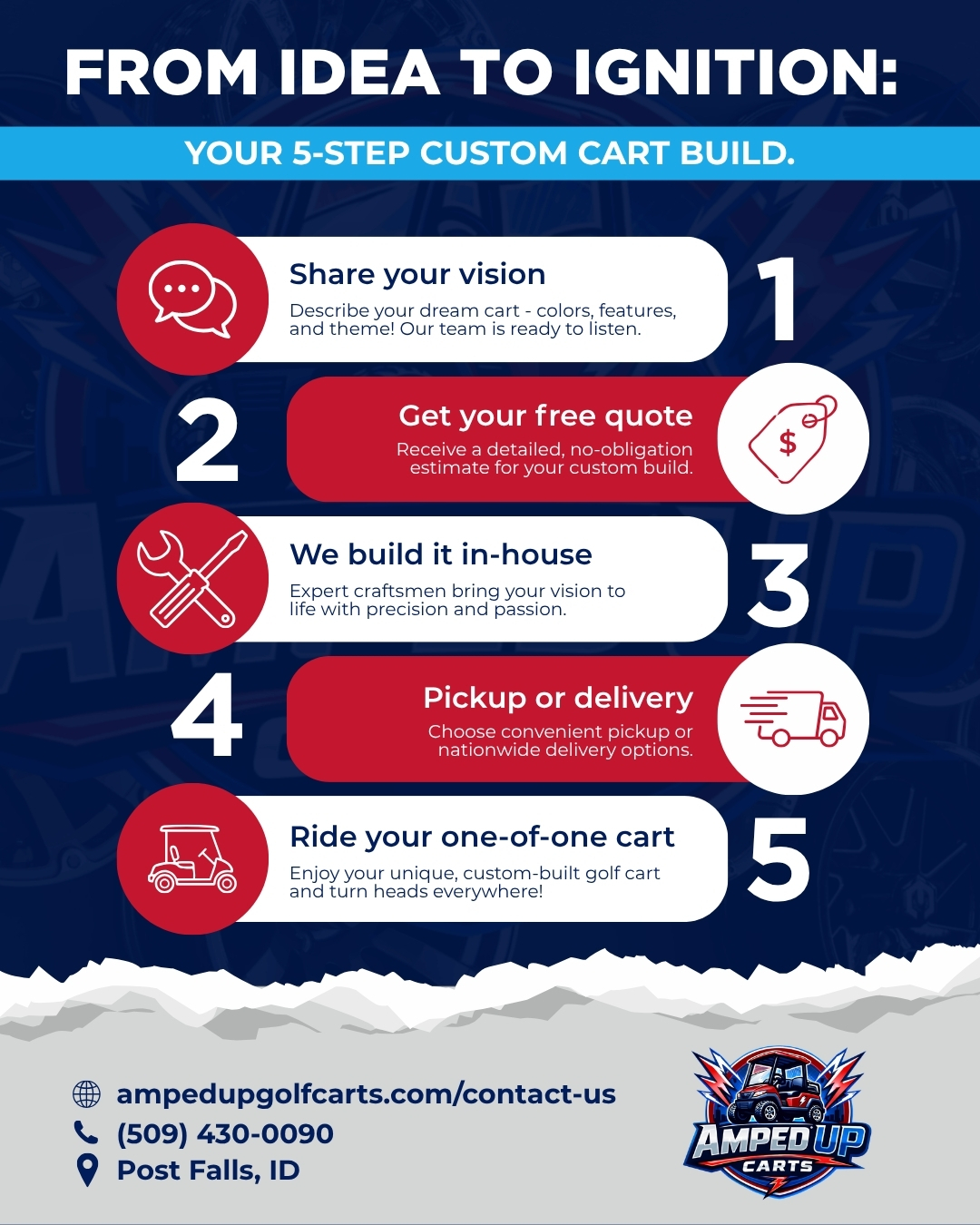
A custom build sounds like a big undertaking, but from your side, it is refreshingly simple. Here is how it goes, start to finish.
1. Tell us your vision. Call, text, or message us with how you want to use the cart and the look you are after. Photos of your current cart help if you have one.
2. Get your free quote. We map out the build and the cost, walk you through the options, and give you a realistic timeline, with no pressure and no surprises.
3. We build it. Our factory-certified techs handle every upgrade in-house with quality parts from trusted brands like Evolution, Icon EV, Star, MadJax, GTW, and Navitas.
4. Pickup or delivery. We bring it to you anywhere in the Inland Northwest, or you can swing by the shop in Post Falls, whichever is easier.
5. Ride. You hit the lake, the neighborhood, or the trail in a cart that is truly one of one.
How Do You Take Care Of A Custom Golf Cart?
A custom cart is an investment, and a little upkeep keeps it looking and running great for years. The good news is that modern carts, especially lithium-powered ones, are low-maintenance by design. A few simple habits go a long way.
- Keep it charged. Lithium batteries like to be topped up and stored with a healthy charge, especially heading into winter. They are far more forgiving than old lead-acid packs, but they still appreciate good habits.
- Check your tires. Proper tire pressure means a smoother ride, better range, and longer tire life. It takes two minutes and makes a real difference.
- Rinse off the adventures. Lake spray, trail dust, and grass clippings are easy to wash off and much harder to ignore. A regular rinse and wipe-down protect your finish.
- Store it smart for winter. When the season winds down, a clean, charged, covered cart in a dry space is the recipe for a trouble-free spring.
One thing worth knowing: we are a custom build and upgrade shop, not a general repair shop. We proudly service and stand behind the carts we have built or modified, but we do not take on general repairs for carts we did not work on. If your cart is one of ours, we have your back.
Why Build With Amped Up Carts?
There are a few places to buy a cart in the region, so here is the straight answer on what makes building with us different.
- Everything happens in-house. Our factory-certified techs handle every upgrade themselves, so the quality is consistent and nothing gets farmed out.
- We use trusted, name-brand parts. Evolution, Icon EV, Star, MadJax, GTW, and Navitas are not mystery components, so your build holds up.
- Real craftsmanship and detail. Every cart is personalized and built with attention to the details that make it feel finished, not bolted together.
- A 4.9-star reputation. Customers across the Inland Northwest consistently call out our work, our communication, and our seamless pickup and delivery.
- Pickup and delivery included. We come to you anywhere in the region, so distance is never a reason to settle.
- A standing thank-you. Active duty, veterans, and first responders get 15% off every day of the year.
We are a passionate, local shop that genuinely loves this work, and it shows in the carts that roll out our doors all summer long.
Where Can I Get A Custom Golf Cart Near Me?
Amped Up Carts is based in Post Falls, Idaho, and we serve the entire Inland Northwest. Whether you are searching for a custom golf cart in Post Falls, a lifted cart in Coeur d’Alene, golf cart upgrades in Hayden or Liberty Lake, or a full custom build in Spokane, we have you covered, and with free pickup and delivery, your zip code never limits what you can build.
That includes the gated communities on the lake. We cover golf carts at Black Rock and the Rockford Bay area on the same run, with delivery arranged to the gate.
You will find us at 5210 E. Seltice Way, Suite 104, Post Falls, ID 83854, open Monday through Friday from 9 to 6 and Saturday from 10 to 6. Stop in to talk through ideas, or start online at ampedupgolfcarts.com.
How To Get Your Free Quote
Ready to find out what your build would cost? It takes about two minutes to get the ball rolling, and there is zero pressure attached.
- Request a quote at ampedupgolfcarts.com/contact-us.
- Call or text us at (509) 430-0090.
- Stop by the shop at 5210 E. Seltice Way, Suite 104, Post Falls, ID 83854.
- Active duty, veterans, and first responders: ask about your standing 15% discount.
Let us know what you are picturing. We will handle the rest, and you can spend the rest of the summer enjoying the ride.
Final Thought: Summer’s Here. Let’s Build The Cart You Keep Picturing.
You do not need every detail figured out before you reach out. Let us know how you want to use it and what you like, and we will help you shape the rest. Whether it is a couple of upgrades or a full ground-up custom build, we will give you an honest quote and build something you are proud to pull up at the lake all summer long.
Let’s build it: ampedupgolfcarts.com/contact-us | (509) 430-0090 | 5210 E. Seltice Way, Suite 104, Post Falls, ID 83854


